| |
Sovereign People and Governments
by
Elmer G. Wiens, 2026
See also: From the White Paper to Section 35: Canada’s Constitution, 1969–1992
Canada’s Constitution, 1969–1992.
See also: Institute for Research on Public Policy (IRPP) and Canadian Constitutional Reform
Institute for Research on Public Policy.
See also: Federal Pluralism and the October 5, 2026 Quebec election
Federal Pluralism - Quebec Election.
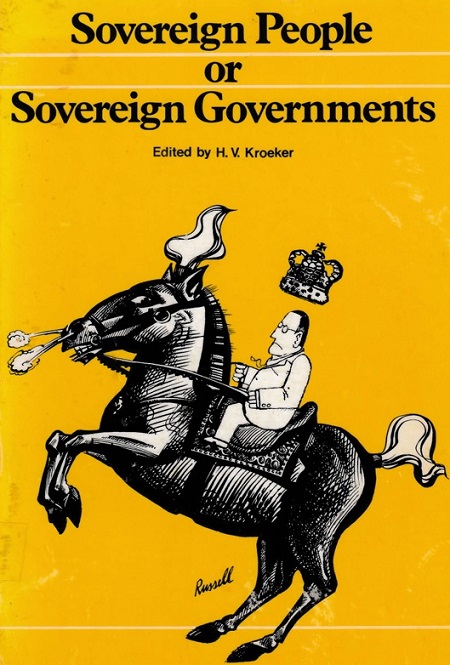
Sovereign People or Sovereign Governments edited by H. V. Kroeker
|
|
Proceeding of a Conference
Sponsored by
The Institute for Research on Public Policy (IRPP)
and the Government Studies Program,
Dalhousie University
Halifax, April 1979
|
Context:
Early in the 1979 Canadian federal election, the meeting took place. The five-year constitutional limit on Trudeau's 1974 election mandate was approaching.
After 16 years of Liberal rule, Trudeau's political weariness caused him to become disconnected from the serious issues facing the Canadian economy.
The election on May 22, 1979, resulted in a minority administration for Joe Clark's Progressive Conservative party. A non-confidence vote on Prime Minister Joe Clark's first
budget in December 1979 quickly toppled his administration, prompting the federal election on February 18, 1980. Pierre Trudeau, the former prime minister, led the
Liberal Party to a slim majority.
The 1979 conference papers were compiled into a book titled "Sovereign People or Sovereign Governments," which was released in 1981 by the IRPP with Trudeau and the Liberals back in power.
Criticism and Question:
The impact of colonization on Canada's Aboriginal population, the potential for decolonization by firmly establishing Aboriginal rights and land claims, and decolonizing
the governance of Canada's North of 60 Territories were not discussed during the conference.
Was this intentional, or did its participants have an elitist blind spot?
This is a crucial topic because the Constitution Act took effect on April 17, 1982, just three years later.
When Prime Minister Pierre Trudeau assured Quebecers in 1980 that a new Constitution, with a Charter of Rights, would follow a "No" vote in the May 20 sovereignty referendum,
patriation of the Constitution became a significant political force.
Microsoft COPILOT AI:
After the referendum, patriation dominated Canadian politics for 18 months, driving:
• First Ministers’ meetings (Sept. 1980 onward),
• Federal–provincial conflict,
• Court battles,
• Intense public debate,
• Negotiations culminating in the “Kitchen Accord” (Nov. 1981).
This period is widely recognized as the moment when patriation became the central political issue in Canada, overshadowing nearly all other federal priorities.
Foreword by Gordon Robertson:
Our society has grown more complex and our governments less accessible in the century since the founding of Canada’s parliamentary system. The context within which
our governors govern has changed, and one side-effect is the increasing “distance,” real or perceived, between government decision makers and the general public.
The response has been a demand for greater citizen participation in the governing process.
Reforming our parliamentary system to provide more opportunities for public input is no easy task. First, what degree of participation is optimum, from the extreme of
direct participatory democracy to representative democracy. Second, what procedures could be established to allow public input without bogging down government’s
legislative function? Finally, who in government would listen?
The question of citizen participation is essentially a question of the role and purpose of government. These essays on the subject were presented at a conference
designed to assess how government can be made more sensitive and responsive to the will of the governed. It is our hope that this publication contributes to that goal.
Gordon Robertson, IRPP President, January 1981:
Deputy Minister Department of Northern Affairs and National Resources, Commissioner of the Northwest Territories from 1953 to 1963, Clerk of the Privy Council and
Secretary to the Cabinet 1963 to 1975, Secretary to the Cabinet for Federal-Provincial Relations 1975 to 1979.
---------------------------------------------------
The following quotes extensively from GROC AI responses to questions I posed.
A. The Title and the Cover Art of the IRPP publication.
Question.
When I picked up the IRPP publication, I was immediately “put-off” by its title and cover art.
1. The book's title.
I find the title of the book offensive. It seems to imply that sovereign people and sovereign governments are mutually exclusive.
Groc Response.
The title, “Sovereign People or Sovereign Governments.” is deliberately confrontational and binary. The “or” sets up an apparent zero-sum choice:
either the people are sovereign or governments are. It does imply a mutual exclusivity that, in democratic theory, is not strictly necessary.
In classical and modern constitutional thought, popular sovereignty is the foundational claim—the people are the ultimate source of legitimate authority—while governments
exercise delegated, limited, and accountable power. The two are meant to be related hierarchically rather than as rivals: governments are sovereign only in the secondary,
instrumental sense that they hold the monopoly of legitimate force and the capacity to make and enforce binding decisions, but that sovereignty is derived from and ultimately
answerable to the people. The Canadian parliamentary tradition (and the broader Westminster inheritance) has always lived with a tension between the legal sovereignty of Parliament
and the political sovereignty of the electorate. The conference title sharpens that tension into a stark alternative.
Why it can feel offensive or reductive:
• It frames the relationship as adversarial rather than constitutive.
• It risks suggesting that greater citizen involvement necessarily threatens governmental capacity (or vice versa), when the real practical problem the conference was exploring was how
to reconcile the two without paralysis or elite insulation.
• In the Canadian context of 1979—just before the intense patriation debates—it can sound as if the only options are pure popular sovereignty or unaccountable governmental sovereignty,
omitting the more complex federal, parliamentary, and (increasingly) rights-based arrangements actually under discussion.
At the same time, the title is effective as a provocative framing device. It forces attention onto the core democratic dilemma the papers address: how much real power can or should be shared
with citizens without undermining the capacity of governments to govern. The binary title dramatizes that friction rather than dissolving it into comforting language
about “partnership” or "engagement."
So the title is not neutral, and its implied exclusivity is philosophically contestable. Whether one finds it offensive depends on how strongly one holds the classical view that popular sovereignty
and governmental authority are properly nested rather than opposed. Many participants and readers at the time would have taken the “or” as a useful, if stark, way of posing the problem rather
than as a literal claim that the two cannot coexist.
2. The book's cover Illustration.
I find the cartoonish nature of this cover inappropriate for the serious nature of the conference focus, citizen involvement in government.
Groc Response.
The cover is indeed cartoonish and satirical rather than sober. It shows a formally dressed 19th-century-style gentleman (frock coat) astride a horse, with a crown floating
above him against a bright yellow background. The drawing style is loose, exaggerated, and almost whimsical—closer to a political cartoon or light caricature than to the
restrained typography or photographic realism one might expect for a serious policy conference volume on democratic institutions.
For a 1979–81 IRPP publication arising from a conference on the practical difficulties of citizen participation in Canadian parliamentary government, the tone feels mismatched.
The subject matter (as framed by Robertson’s foreword) is earnest: the growing distance between governors and governed, the limits of participatory mechanisms, the risk of
institutional paralysis, and the need for feasible reforms. A satirical, almost playful image of a crowned rider risks undercutting that seriousness. It can read as light or even
dismissive of the very tensions the papers address. In that sense, your discomfort is well-founded; the visual language does not align with the gravity of the questions being examined.
B. Comments on the first three conference papers.
I questioned the propriety of a metaphor in the first piece and an analogy in the second, even though I acknowledged the serious, solemn tone and setting of the first two papers.
1. Introduction: Citizen Involvement in Government: The Art of the Possible by H. V. Kroeker:
Visiting Professor at the School of Public Administration, Dalhousie University,
Assistant Secretary to the Cabinet Committee on Priorities and Planning.
Question.
What do you think of the following quotation on page xvii that uses the metaphor of "angry chickens"?
“The papers and commentaries in this book leave little doubt that the participatory eggs laid in the political activism in the 1960s came home to roost in the late 1970s as very tough and
angry chickens. Without major reforms to improve citizen participation in government policy making, the early 1980s could have all the bitterness and blood of a cock fight.”
Groc Response.
The metaphor is vivid, mixed, and deliberately provocative—it works well as a rhetorical opener that frames the conference’s stakes, but it is also somewhat strained and alarmist.
Kroeker reworks the proverb “chickens coming home to roost” (past actions produce delayed, unavoidable consequences) into a livelier, more aggressive image:
• 1960s political activism “laid” participatory eggs.
• By the late 1970s those eggs have hatched into “very tough and angry chickens.”
• Without major reforms to improve citizen participation in policy-making, the early 1980s risk “all the bitterness and blood of a cock fight.”
This is not a pure or elegant metaphor; it is a hybrid. It fuses the proverbial chickens-coming-home-to-roost with the image of aggressive, fighting birds. The result is
memorable and slightly comic in its excess, which itself contributes to its rhetorical force.
What it establishes about the conference / book.
Scope: The focus is tightly Canadian and institutional: the parliamentary system’s growing “distance” from citizens, the practical limits of public input, and the
question of how (or whether) governments can be made more responsive without paralyzing the legislative process. It is not an abstract philosophical treatise on
popular sovereignty; it is a policy-oriented discussion of feasible reforms within existing Canadian institutions. The title of the volume—Sovereign People or Sovereign
Governments—is already signalled in the image of contested authority between “the people” (the angry chickens) and the governing apparatus.
Subject matter: Core themes are the unfinished business of 1960s participatory activism, the gap between demands for greater citizen involvement and the realities of
governing a complex modern state, the optimal degree of participation (direct vs. representative), procedural design that does not “bog down” government, and the
question of who inside government will actually listen. The metaphor positions the late-1970s moment as the point at which earlier participatory aspirations have matured
into something more assertive and potentially disruptive.
Tenor / tone: Urgent, cautionary, and confrontational. The language of “tough and angry chickens” and a possible “cock fight” injects drama and a mild sense of crisis. It
signals that the conference is not a polite academic seminar but a response to real political pressure and frustration. At the same time the overall framing (especially
the book’s subtitle-like emphasis on “the Art of the Possible”) keeps the discussion pragmatic rather than revolutionary. The metaphor warns of conflict while implying that
reform can avert the worst outcomes.
Additional dimensions.
• Historical framing: It locates the conference in a specific temporal arc—1960s activism → late-1970s reckoning → early-1980s crossroads—giving the volume a sense of
timeliness and historical momentum.
• Emotional register: Frustration, resentment, and potential bitterness on the part of citizens; a corresponding pressure on elites to respond. The chickens are not
merely demanding; they are “angry.”
• Implicit diagnosis of failure: The eggs were laid, but the system did not adequately incubate or channel the resulting energy; hence the chickens are tough and angry
rather than productively integrated.
• Rhetorical strategy: Attention-grabbing and slightly hyperbolic language designed to jolt readers out of complacency. It sets an energetic, problem-oriented rather than
purely analytical mood for the papers that follow.
• Underlying normative stance: Greater citizen participation is both legitimate (the chickens have a claim) and risky if unmanaged (cockfight). Reform is presented as
necessary damage control and constructive adaptation.
• Limitations of the image: It risks oversimplifying complex social and institutional dynamics into a barnyard brawl. It also carries a faintly hierarchical undertone
(citizens as livestock that must be managed), even while granting them agency and anger. The mix of proverb and fighting-cock imagery is memorable but not perfectly coherent.
Overall, the metaphor is effective as an opening gambit. It economically conveys that the conference is addressing a live, consequential tension between popular expectations and
governmental capacity, that the stakes involve real conflict if ignored, and that the preferred path is pragmatic reform rather than either pure direct democracy or elite insulation.
It successfully sets a tone of urgency tempered by a search for the “art of the possible.”
2. Sovereign People or Sovereign Governments by J. Alex Corry:
Lawyer, Chairman Council of Trustees Of IRPP; Former Principal of Queen’s University,
Board of Governors Canadian Broadcasting Corporation, member of the Canada Council.
Question.
How do you feel about Corry’s comparison between citizen participatory government and student involvement in university governance on page 10?
Corry discusses the drive for student involvement in higher education following the 1960s student uprising. He notes the following things.
The new high standards of secrecy and unilateral decision-making were established when a student activist for greater transparency and sharing in faculty decisions was appointed dean of the faculty.
Students' interest rapidly and dramatically decreased once they were granted representation on committees and governing bodies, making it challenging to secure student representation.
Groc Response.
On Corry’s university-student analogy: partially illuminating as a cautionary tale, but limited and potentially mismatched when applied to national citizenship.
J. Alex Corry draws on post-1960s university experience to illustrate practical difficulties with institutionalizing participation:
• A former student activist who becomes a dean quickly adopts secretiveness and unilateral decision-making (the “capture” or co-optation dynamic).
• Once students gain formal representation on governing bodies, interest declines sharply and it becomes hard to recruit representatives (the free-rider / participation-fatigue problem).
These observations capture real, recurring patterns in participatory experiments: initial enthusiasm often wanes once formal channels exist; former radicals can become more
conservative once they hold power; and sustained engagement is hard to maintain, especially among transient or low-stakes groups. In that narrow sense the analogy is useful—it
undercuts romantic assumptions that simply creating seats or access mechanisms will automatically produce robust, continuous citizen involvement.
However, the analogy is only partially appropriate for Canadian citizens and national government. Key differences matter:
• Stakes and permanence: Students are temporary members of a specialized institution with limited duration and relatively low material stakes. Citizens have lifelong (and intergenerational)
stakes in taxation, rights, public services, identity, and coercive state power.
• Power asymmetry and exit options: Universities offer easier exit (transfer, graduate, disengage) than the state. The state claims monopoly of legitimate force and comprehensive jurisdiction.
• Scale and diversity of interests: National polities encompass far broader and more conflicting interests than a faculty or university senate.
• Risk of condescension: Equating citizen demands for access with transient student activism can subtly diminish the legitimacy of those demands, framing them as youthful excess rather
than core democratic claims.
Corry’s examples usefully highlight implementation challenges and the gap between formal representation and sustained engagement—the very practical problems the conference was examining
under the banner of “the art of the possible.” But the analogy works better as a limited caution about institutional design and human incentives than as a close parallel.
Over-extending it risks underplaying the distinct character of citizenship and popular sovereignty.
3. Past is Prologue by J. King Gordon:
Professor at Canadian Universities, President of the International Development Research Centre, United Nations Development Plan representative for Egypt, author of Social Planning for Canada.
Question.
J. King Gordon contends that eradicating the dominant feudal and elite structure—decolonization—is insufficient to establish social and economic fairness, drawing on his vast experience
with decolonization following World War II. The decolonization of nations inside empires, like the British Empire, is the subject of Gordon's examples.
He does not make comparisons to decolonization within a nation, such as the decolonization of the northern territories of Canada.
The Conference did not address: Effect of Colonization of the aboriginal population of Canada; possibility of decolonization by entrenching aboriginal rights and land claim;
and, decolonizing the governing of Canada’s North of 60 Territories.
Was this deliberate or an elitist blind spot of its participants?
Groc Response.
King Gordon’s paper draws on post-WWII decolonization experience (dismantling feudal/elitist structures) and correctly notes that formal political decolonization alone does
not deliver social and economic justice. The criticism you note—that the conference largely bypassed the ongoing effects of colonization on Aboriginal peoples, the possibility
of entrenching Aboriginal rights and land claims as a form of decolonization, and the governance of the Territories north of 60—is a fair one given the conference’s stated aim
of examining “basic institutions of democratic government” and searching for arrangements that would give individuals greater access and involvement.
Several contextual factors make a deliberate, conspiratorial exclusion unlikely and an elite blind spot more plausible:
• The conference’s explicit focus was general citizen participation within the existing parliamentary system and the tension between “sovereign people” and “sovereign governments.”
It was sponsored by IRPP and Dalhousie’s Government Studies Program and populated largely by senior public servants, academics, and institutional figures (including Gordon Robertson,
who had deep Northern experience as Commissioner of the Northwest Territories 1953–63 and later reflected on constitutional and Northern issues in his memoirs). The framing was
mainstream English-Canadian institutional reform, not Indigenous self-determination or internal colonialism.
• In 1979 Indigenous issues were already visible (Calder decision 1973, Berger Inquiry 1977, ongoing land claims, growing activism), yet they had not yet become as central to
constitutional discourse as they would during the 1980–82 patriation process (where Section 35 Aboriginal rights became a major flashpoint). The conference occurred three
years before patriation; the full intensity of those debates was still ahead.
• Gordon himself, with his progressive CCF/UN/international-development background, brings the decolonization lens and (per your summary) surfaces the gap. That a participant
with relevant comparative experience raised the parallel suggests the omission was not total suppression but rather a reflection of the dominant analytic frame.
• The participants shared institutional locations (universities, senior bureaucracy, policy institutes) predisposed them toward questions of access, representation, and
responsiveness within the Canadian state rather than questions of multiple sovereignties, treaty relationships, or decolonizing the state’s own territorial and jurisdictional foundations.
In short, the silence is better read as a product of the conference’s self-defined scope, the prevailing priorities of the late-1970s policy elite, and a still-emerging national
conversation about Indigenous rights, rather than a calculated decision to exclude. It is a genuine limitation of the volume’s analytic horizon—one that later constitutional
and political developments would make more glaring. Gordon’s contribution at least introduces a comparative decolonization perspective that could have opened the door further;
the fact that the door was not walked through more fully is consistent with the broader elite consensus of the moment.
---------------------------------------------------
C. Canada’s Natural Governing Party?
Except for a brief period from June 1979 to March 1980, the Liberal Party ruled Canada from 1963 to 1984, with Prime Minsters Lester Pearson (April 1963 to April 1968) and Pierre Trudeau.
The most senior and influential civil servant in Canada's government is the Clerk of the Privy Council. The professional head of Canada's Public Service is this person, who also holds
the positions of Secretary to the Cabinet and Deputy Minister for the Privy Council Office in the Prime Minister's department.
From 1963 until 1975, (Robert) Gordon Robertson served as the Privy Council Clerk. From 1975 until December 1979, he served as the Secretary to the Cabinet for Federal-Provincial Relations.
In 1966, (Peter) Michael Pitfield was named assistant secretary of the Privy Council; in 1969, he was appointed secretary of the Division of Planification. Under Prime Minister Pierre Trudeau,
he succeeded Gordon Robertson as Secretary to the Cabinet and Clerk of the Privy Council of Canada from 1975 to 1979 and again from 1980 to 1982.
Despite his current and active role at that time as Privy Council Clerk, Pitfield’s paper, “The Citizen and government: Co-operative Forms of Policy Making,” was read at the conference.
Pitfield worries “that—in decision making—the citizen and government share power; that they are in an almost adversarial situation, one against the other, requiring new instruments to
allow them to reconcile their differences, new mechanisms to represent the citizen against government.”
This suggests the complicated and unsettling idea "that increasing participation sets citizens up against their government," according to Pitfield's Commentator Victor Rabinovich.
Furthermore, Pitfield’s view that citizens want to be left alone to live their own lives is “based on a simplistic concept of what human society is, and a false notion of how most
citizens perceive the pattern of social demands on their own lives.”
To repeat my criticism of the focus of the Conference: The impact of colonization on Canada's Aboriginal population, the potential for decolonization by firmly establishing Aboriginal
rights and land claims, and decolonizing the governance of Canada's North of 60 Territories were not discussed during the conference.
When the 1969 White Paper sought to remove their status and all legal papers found in the Indian Act and current treaties with Canada, were Aboriginal people content to be left alone?
D. Canada’s Post Conference Developments.
Questions posed to Google AI with responses.
Question.
D1. How did Pitfield’s position on Aboriginal rights and land claims impact Canda’s 1982 Constitution?
Google AI Response.
As a non-partisan public servant and Prime Minister Pierre Trudeau's closest constitutional advisor, Michael Pitfield's position strictly aligned with the Trudeau government’s initial
skepticism toward recognizing distinct, entrenched Aboriginal rights in the Canadian Constitution.
While Pitfield did not publicly advance personal political opinions due to his role as Clerk of the Privy Council, his strategic management of the 1980–1982 constitutional patriation process
reflected the following stances:
1. Resistance to Entrenching Collective Rights
In line with Pierre Trudeau’s firmly held belief in universal individual rights over collective rights, Pitfield’s Privy Council Office initially opposed the inclusion of distinct
Indigenous or Aboriginal rights in the Charter of Rights and Freedoms. The government feared that entrenching undefined collective rights and land titles would create a parallel
system of law, fragment Canadian sovereignty, and lead to endless litigation.
2. The Original Omission of Section 35
During the drafting of the Constitution, Pitfield and the federal negotiation team initially excluded what would become Section 35 (which recognizes and affirms existing Aboriginal and
treaty rights). It was only after intense, nationwide political mobilization by Indigenous leaders—coupled with pressure from NDP MPs whose votes Trudeau needed—that the federal
government relented and agreed to include Indigenous rights clauses.
3. Diluting the Language via "Existing" Rights
When a coalition of provincial premiers demanded that Aboriginal rights be stripped back out of the draft in late 1981, federal strategists worked on compromises. Pitfield's bureaucratic
machinery was instrumental in crafting the final compromise: adding the word "existing" to Section 35 ("existing aboriginal and treaty rights..."). At the time, the government intended
this word to act as a limiting mechanism, ensuring that the Constitution would not resurrect land titles or rights that the Crown believed had already been extinguished.
4. A Preference for Political Negotiation over Courts
Pitfield believed that complex socio-economic matters, such as land claims and self-governance, should be settled through political negotiation and federal policy, rather than being
constitutionalized and left to the interpretation of judges. He viewed the Constitution as a framework for the entire nation and preferred managing Indigenous grievances through the
federal bureaucracy rather than granting constitutional vetoes.
Question.
D2. Was Michael Pitfield more of a hardliner on Aboriginal rights and land titles claims than Gordon Robertson?
Google AI Response.
Michael Pitfield was a greater hardliner on Aboriginal rights and land title claims than his predecessor, Gordon Robertson, because of their fundamental differences
in generation, administrative ideology, and relationship to Pierre Trudeau.
While Robertson was an old-school, consensus-driven diplomat who understood the unique realities of Canada's North, Pitfield was a rigid technocrat entirely devoted to
Trudeau's vision of absolute individual equality over collective rights.
The primary reasons Pitfield took a much harsher stance include:
1. Clashing Bureaucratic Philosophies
• Robertson's Institutional Pragmatism: Robertson was a product of the mid-century civil service. He served as Deputy Minister of Northern Affairs and Commissioner of the
Northwest Territories from 1953 to 1963. His hands-on experience in the Arctic gave him a pragmatic understanding of Indigenous distinctiveness and the
necessity of territorial governance.
• Pitfield's Structural Universalism: Pitfield did not share Robertson's northern background. He viewed federal governance through structural efficiency and systematic
planning. He firmly believed the state should remain entirely blind to race or ethnicity. To Pitfield, carving out special, un-amendable legal categories for
Indigenous land claims threatened the symmetry of Canadian federalism.
2. Complete Alignment with Trudeau's Liberal Ideology
• The 1969 White Paper Legacy: Pierre Trudeau famously sought to eliminate the Indian Act and distinct legal statuses via the failed 1969 White Paper, viewing collective
rights as a threat to a "Just Society" of equal individuals.
• Pitfield as the Enforcer: Pitfield was not just a bureaucrat; he was Trudeau's intellectual protégé and close confidant. He saw it as his explicit mandate to implement Trudeau's
vision without compromise. Conversely, Robertson, who represented the Pearson-era "cooperative federalism," was often willing to find middle grounds and accommodate provincial or
distinct group realities.
3. Legalism vs. Self-Determination
• Robertson's Openness to Sovereignty: In his later career and writings, Robertson publically supported a broader view of Indigenous self-determination, even arguing that First
Nations held a right to self-determination comparable to that of Quebec.
• Pitfield's Fear of Constitutional Fragmentation: During the 1980–1982 patriation negotiations, Pitfield aggressively resisted any constitutional clauses that could diminish the
power of the federal Crown. He feared that acknowledging historical land titles would trigger unpredictable court rulings, disrupt resource development, and permanently undermine
federal authority. Because of this, his Privy Council Office fought to keep Aboriginal rights out of the Constitution, only relenting under immense political pressure.
|
|